Grip Strength, VO2 Max, and Walking Speed: Three Free Predictors of How You'll Age
No blood draw needed. These three simple, well-researched measures are some of the strongest predictors we have of how you'll age, and you can test them today.
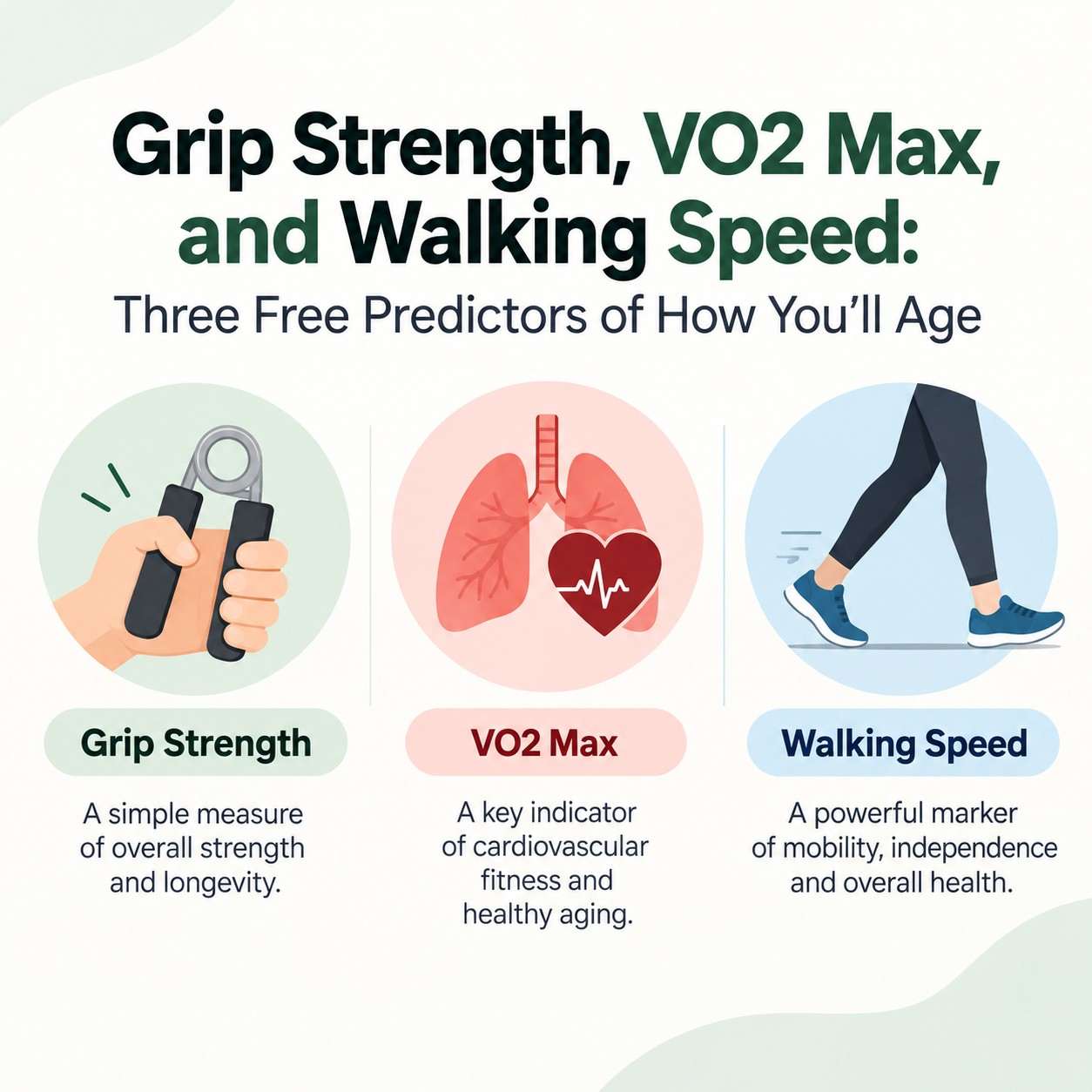
Not every useful longevity marker requires a blood draw or an expensive scan. Some of the most well-studied predictors of healthy aging are functional measures you can estimate with basic equipment, or in one case, nothing at all. Grip strength, VO2 max, and gait (walking) speed have each been tracked across large, long-term cohort studies, and each has repeatedly shown a strong, independent association with future health outcomes.
Grip Strength
Grip strength is measured with a handheld dynamometer, an inexpensive device many physiotherapy clinics and gyms have on hand. It's used as a simple proxy for overall muscular strength, and research consistently links lower grip strength to higher risk of frailty, cardiovascular events, and all-cause mortality, independent of age and other risk factors. It's a genuinely useful marker precisely because it's easy to measure repeatedly and tracks meaningfully with overall muscle health.
Rough benchmarks (dominant hand, values vary by age and study population): men in good strength condition often exceed 35–40 kg, and women often exceed 22–25 kg, with strength predictably declining with age if not actively maintained through resistance training.
VO2 Max
VO2 max measures the maximum rate at which your body can use oxygen during intense exercise, essentially a direct measure of cardiorespiratory fitness. It's traditionally measured in a lab with a treadmill or bike test and breathing apparatus, though modern fitness trackers and smartwatches now provide reasonably useful estimates for general tracking purposes. Large population studies have repeatedly found cardiorespiratory fitness to be one of the strongest predictors of long-term mortality risk among modifiable factors, in some analyses outperforming traditional risk factors like blood pressure and smoking status.
What affects it: VO2 max responds directly to aerobic training, particularly a mix of steady-state cardio and higher-intensity interval work, and tends to decline gradually with age and inactivity if not actively maintained.
How These Three Measures Interact
Grip strength, VO2 max, and walking speed aren't independent, unrelated numbers; they overlap and reinforce each other, which is part of why each one predicts outcomes so consistently across different studies. Someone with strong grip strength typically has better overall muscle mass, which supports faster walking speed and a more efficient metabolic rate. Someone with a higher VO2 max has a cardiovascular and respiratory system capable of delivering oxygen efficiently during any physical activity, including everyday tasks like climbing stairs, which shows up indirectly in a comfortable, confident walking pace. This is why a physician looking at all three together gets a more complete picture of functional health than any single measure alone, and why improving one, most often through resistance training, tends to nudge the others in the right direction as well.
Age-Related Decline Isn't Fixed
All three measures naturally decline with age if left unaddressed, muscle mass and strength particularly from the 30s onward at a rate that accelerates further after 60 without active resistance training. What the research consistently shows, however, is that this decline is substantially modifiable, not fixed. Older adults who begin structured resistance training, even for the first time in their 60s or 70s, reliably show measurable improvements in strength and function within a matter of months, which is a meaningfully different message than the common assumption that decline is simply an inevitable, unmodifiable part of aging.
Walking Speed (Gait Speed)
Usual walking speed, typically measured over a short, flat distance, sounds almost too simple to be meaningful, yet it has been validated across numerous studies as a strong predictor of health outcomes, particularly in older adults, correlating with muscle mass, cardiovascular fitness, cognitive function, and overall physiological reserve. A commonly cited benchmark is that a comfortable walking speed above roughly 1.0 meter per second (about 3.6 km/h) is generally associated with better health outcomes, while notably slower speeds warrant closer attention.
How to Test All Three Yourself
Grip strength: most gyms, physiotherapy clinics, or sports medicine centres have a hand dynamometer; a single test takes under a minute.
VO2 max: a smartwatch estimate is a reasonable starting point for tracking trends over time; a formal lab-based cardiopulmonary exercise test gives a more precise number if you want it.
Walking speed: time yourself walking a measured 10-metre distance at your normal, comfortable pace, and divide distance by time.
None of these tests require special preparation, and repeating them every few months, ideally under similar conditions each time, gives a far more meaningful picture than a single measurement compared to a generic population benchmark.
What to Do If Your Numbers Are Low
All three measures respond to training. Grip strength and walking speed improve with regular resistance training, particularly for the legs, back, and core. VO2 max improves with consistent aerobic exercise, including both moderate-intensity steady-state work and higher-intensity intervals. Neither requires elite athletic training to move meaningfully; consistency over months matters more than intensity in any single session. Our physiotherapy programme and longevity programme both use these measures as concrete, trackable targets rather than abstract goals, alongside the biomarker and biological age testing covered in our related article. Starting from wherever your current numbers sit, and tracking the trend rather than fixating on a single benchmark, is a far more useful approach than comparing yourself to a generic population average.
Frequently Asked Questions (FAQs)
1. Can these tests be done at home without any equipment?
Walking speed can be measured with nothing more than a tape measure and a stopwatch. Grip strength requires a dynamometer, though many gyms and physiotherapy clinics have one available for a quick check.
2. What is a good grip strength for my age?
Benchmarks vary by age and sex, but broadly, men over roughly 35-40 kg and women over roughly 22-25 kg (dominant hand) are often considered strong ranges, with a general expectation of gradual decline with age unless actively maintained.
3. Can I estimate VO2 max without a lab test?
Yes, most modern smartwatches and fitness trackers provide a reasonably useful VO2 max estimate based on heart rate and pace data during exercise, sufficient for tracking trends over time even if less precise than a formal lab test.
4. Why does walking speed predict health outcomes?
Usual walking speed reflects a combination of muscle strength, cardiovascular fitness, balance, and neurological function, which is why it correlates so strongly with broader health status, particularly in research on aging populations.
5. How quickly can grip strength improve with training?
With consistent resistance training two to three times a week, measurable improvements are often seen within 8-12 weeks, though continued gains typically require sustained training over months.
6. Is VO2 max more important than blood pressure or cholesterol for longevity?
Several large studies have found cardiorespiratory fitness to be one of the strongest predictors of mortality risk among modifiable factors, in some cases outperforming traditional risk factors, though it should be viewed as complementary to, not a replacement for, standard risk factor management.
7. Do these measures matter for younger adults, or only older adults?
They matter across the lifespan. Building strength and fitness capacity earlier in life creates a larger reserve to draw on as natural age-related decline occurs, making these worth tracking well before symptoms of frailty ever appear.
This article is for educational purposes and does not replace personalized medical advice. Please consult a qualified physician before making changes to your treatment, medication, or health screening plan.