My Blood Test Is Normal But I Feel Terrible: What a Standard Panel Doesn't Check
If your reports say 'normal' but you still feel exhausted, foggy, or off, the problem usually isn't in your head. It's in the tests nobody ordered.
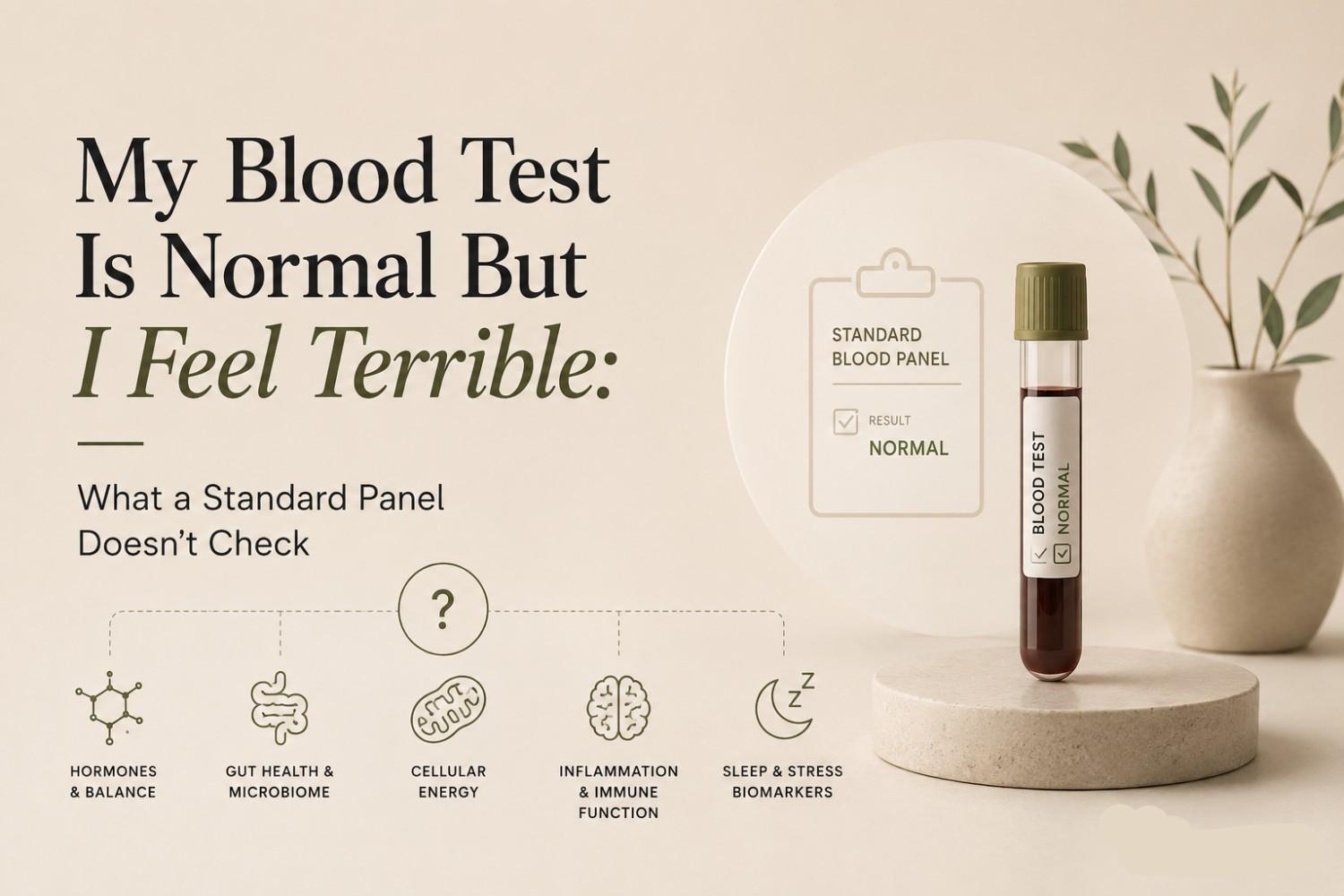
It is one of the most common and most frustrating experiences in medicine: a patient walks in exhausted, foggy, gaining weight for no obvious reason, or simply not feeling like themselves — and the standard health checkup comes back "all normal." Complete blood count, fasting sugar, basic lipid profile, liver and kidney function — every box checked, every number inside the reference range. And yet the person does not feel well.
This is not in your head, and it does not mean the lab made an error. It usually means the panel was never designed to find what is actually going on. A typical annual health package in India covers 25–40 parameters, but most of those parameters are screening tools for late-stage disease, not early metabolic dysfunction. By the time a standard panel turns abnormal, the underlying problem has often been building quietly for five to ten years.
Why "Normal" Doesn't Mean "Optimal"
Reference ranges on a lab report are built from population statistics — they mark where roughly 95% of a tested population falls, not where a person functions best. A fasting glucose of 99 mg/dL is technically "normal," one point below the prediabetes cutoff, yet metabolically very different from a fasting glucose of 85 mg/dL. Total cholesterol of 195 mg/dL looks fine on paper even when the underlying particle count driving arterial plaque is already elevated. Being inside the range and being metabolically healthy are not the same claim.
Six Things a Standard Panel Routinely Misses
1. Fasting Insulin
Almost no routine package includes fasting insulin, yet insulin resistance can precede an abnormal HbA1c by five to ten years. A person can have completely normal glucose and HbA1c while their pancreas is already working overtime to keep it that way — and that extra insulin drives fat storage, post-meal fatigue, and sugar cravings. Our detailed guide on fasting insulin and HOMA-IR explains how to read this test.
2. ApoB (Apolipoprotein B)
Standard lipid panels report total cholesterol, HDL, LDL, and triglycerides. They don't report the actual number of atherogenic particles circulating in your blood, which is what ApoB measures. Two people can have identical LDL cholesterol and very different cardiovascular risk if one is carrying many small, dense particles and the other is carrying fewer, larger ones. We cover this in detail in ApoB vs LDL cholesterol.
3. High-Sensitivity CRP (hs-CRP)
This marker of low-grade systemic inflammation is rarely included in routine packages despite being inexpensive to run. Chronically elevated hs-CRP is associated with higher cardiovascular risk independent of cholesterol, and it is often the biochemical explanation behind unexplained fatigue and body aches.
4. Vitamin D, B12, and Ferritin
These are sometimes included, but rarely interpreted against a functional range rather than the lab's blanket "deficient/normal" cutoff. A ferritin of 15 ng/mL is labelled "normal" on most Indian lab reports despite being low enough to cause fatigue, hair thinning, and poor exercise tolerance in a large number of people, particularly women.
5. Thyroid Antibodies
A standard panel checks TSH. It rarely checks anti-TPO or anti-thyroglobulin antibodies, which can flag autoimmune thyroid disease years before TSH itself becomes abnormal — a common, treatable cause of fatigue, weight change, and brain fog in adults, especially women.
6. HOMA-IR
Because fasting insulin is rarely tested, the HOMA-IR score — a simple calculation estimating insulin resistance from fasting glucose and insulin — is almost never generated, even though it is one of the earliest and most actionable numbers in preventive medicine.
What This Means in Practice
None of this means routine health packages are useless. They remain important for catching genuinely abnormal values and for screening disease that has already progressed. It means "normal" on a basic panel should be the start of the conversation, not the end of it, particularly if you are still experiencing symptoms. A more complete preventive workup adds a relatively small number of additional tests, and it is usually this combination that explains what a "normal" report has been quietly missing.
At iMedi, this expanded panel is the foundation of every longevity and preventive health assessment, precisely because it catches dysfunction years before disease labels apply. Related reading: our guide to the 15 biomarkers worth tracking for healthy aging.
How to Ask for These Tests
You don't necessarily need a specialised clinic to get most of this panel done. Fasting insulin, ApoB, hs-CRP, thyroid antibodies, and a proper vitamin D, B12, and ferritin panel are all standard, validated tests available at any major diagnostic lab in India. The barrier is usually awareness, not access — most people simply don't know to ask, and many routine packages don't include them by default. If you're getting an annual checkup, it's reasonable to specifically request this expanded set rather than accepting the standard package as complete.
A Realistic Example
Consider a 38-year-old with a desk job, six to seven hours of broken sleep most nights, and a family history of type 2 diabetes. Her annual checkup comes back entirely normal: fasting glucose 96 mg/dL, HbA1c 5.5%, total cholesterol 190 mg/dL, hemoglobin within range. On paper, there is nothing to act on. An expanded panel, however, shows a fasting insulin in the upper range with a HOMA-IR suggesting early insulin resistance, an hs-CRP of 2.8 mg/dL indicating low-grade inflammation, and a ferritin of 14 ng/mL, technically "normal" but low enough to explain her persistent afternoon fatigue. None of this appeared in her original report, yet all three findings are directly actionable with lifestyle changes and, in this case, targeted iron repletion.
This is the gap that expanded testing is designed to close: not replacing the standard checkup, but completing the picture it leaves out.
Frequently Asked Questions (FAQs)
1. Why did my doctor say everything is normal if I still feel unwell?
Standard panels are built to catch established disease, not early metabolic dysfunction. Several of the most useful early-warning markers, including fasting insulin, ApoB, and hs-CRP, simply aren't part of a routine package.
2. What tests should I ask for if I feel tired despite normal reports?
A reasonable expanded panel includes fasting insulin (with HOMA-IR), ApoB, hs-CRP, thyroid antibodies, and a properly interpreted vitamin D, B12, and ferritin panel.
3. Can insulin resistance exist with completely normal blood sugar?
Yes. Insulin resistance typically develops years before fasting glucose or HbA1c cross into the abnormal range, because the pancreas compensates by producing more insulin to keep glucose stable.
4. Is ApoB really better than LDL cholesterol for assessing heart risk?
For many people, yes. ApoB reflects the actual number of cholesterol-carrying particles in the blood, which correlates more closely with cardiovascular risk than the LDL cholesterol concentration alone, particularly when triglycerides are elevated.
5. How often should I repeat an expanded panel like this?
Once a year is reasonable for most healthy adults. If you have risk factors, a family history of metabolic disease, or persistent symptoms, your physician may recommend testing every six months until values stabilize.
6. Where can I get this kind of testing done?
A comprehensive preventive health assessment, such as the one offered through iMedi's longevity programme, is designed specifically to include these markers alongside the standard panel.
This article is for educational purposes and does not replace personalized medical advice. Please consult a qualified physician before making changes to your treatment, medication, or health screening plan.